
Greta Plattry
Reconstructing the Career of an American Designer Largely Absent from Fashion History
The University of Alabama Research & Creative Activity Conference (URCA) Award of Excellence
Thalia Cosyleon
Class of 2028

The history of twentieth-century American fashion is defined not only by its celebrated designers, but also by the many individuals whose careers have slipped into obscurity. Beyond a limited list of repeatedly cited names exists a substantial cohort of professionals who shaped ready-to-wear production, regional manufacturing networks, and mid-century style, yet whose contributions remain largely undocumented in academic scholarship. Their garments survive in collections, but their biographies, business practices, and creative trajectories are rarely recorded. This absence is not incidental as it reflects longstanding gaps in fashion historiography that privilege a narrow narrative of influence centered on a few metropolitan icons. Recovering these overlooked designers is essential to constructing a more accurate and inclusive account of American fashion history.
With The Fashion Archive, garments by under recognized American designers such as Vera Maxwell, Mollie Parnis, and Ceil Chapman provide material evidence of substantial yet insufficiently documented careers. Greta Plattry, a New York-based designer working with the same broader professional landscape, similarly remains absent from sustained scholarly discussion. Despite operating in the nation’s fashion capital, Plattry’s career has received little academic attention, and few accessible records trace her professional development. The scarcity of documentation surrounding these designers underscores the urgency of archival recovery and critical assessment.


The Herald Tribune Magazine

Today's Living The Herald Tribune Magazine
Beach Maneuvers by Eugenia Sheppard
page 12, May 18, 1958
Greta Plattry

Greta Plattry was a European-born designer whose work played a meaningful role in the early development of American sportswear. Educated in Europe and influenced by Alpine traditions of dress, she immigrated to the United States in the late 1937, bringing with her a strong foundation in knit and crochet techniques. She initially gained attention for her crocheted accessories, which resonated with an American market increasingly drawn to casual, functional clothing suited to leisure and outdoor activity. From these beginnings, she transitioned into designing full garments, establishing herself within the growing sportswear movement.
In 1941, Plattry launched her own label, producing garments that combined hand-crafted detail with practical design. Her work contributed to a shift in American fashion toward versatility, comfort, and ease of movement, hallmarks of sportswear as it emerged as a distinct category. Her expertise in ski and resort wear led to the design of pieces for the American women’s ski team for the 1947 Olympic season, reinforcing her connection to performance-oriented yet stylish apparel.
Following her success in sportswear, Plattry expanded into more accessible daywear, maintaining a focus on craftsmanship while addressing the needs of a broader consumer base. In the 1960s, she turned her attention to Haiti, where she collaborated with local artisans to produce hand-crocheted garments, continuing her commitment to textile traditions within an international context. She later returned to New York to work within the fashion industry before retiring in 1978. Across her career, Plattry’s integration of handwork and functional design places her among the designers who helped define the character and direction of American sportswear.

Over 80 Years of Fashion History
Ruth Finley

From 1941 to 2014, Ruth Finley published the Fashion Calendar, an independent, weekly periodical that served as the official scheduling clearinghouse for the American fashion industry.
learn more >
A review of Greta Plattry’s career through Ruth Finley’s Fashion Calendar reveals a trajectory that rises quickly, peaks, and then gradually recedes before a brief late return. Her presence builds steadily in the early 1950s, reaching a high point in the mid-decade with the greatest number of documented shows, an indication of strong industry visibility and demand. The following years show a more consistent but moderated output, suggesting she remained established within the fashion calendar even as the intensity of her early success leveled off. By the mid-1960s, her appearances become sparse, pointing to a possible shift away from the formal show circuit. A modest resurgence in the mid-1970s closes the arc, hinting at a return to visibility, though not at earlier levels.


on the cover & in fashion magazines

Dress featured in Vogue, November 15, 1958, page 128


December 6, 1943
January 8, 1945
August 1958
August 1959
sewing patterns
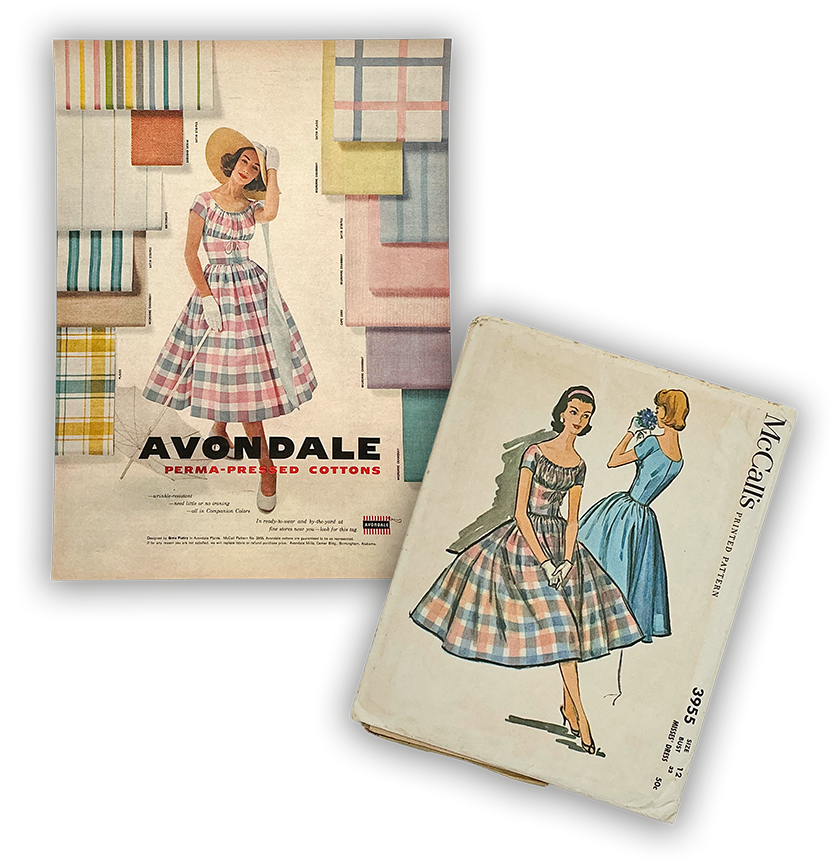
Greta Plattry worked with Avondale Mills during the mid-late 1950s using fabrics designed by alumna J. Diane Bostick.
Founded in 1897 by Braxton Bragg “B.B.” Comer, Avondale Mills grew from a Birmingham startup into a global textile giant that anchored Alabama’s industrial economy for over a century. The company was famous for its “paternalistic” model, providing workers with entire mill villages that included housing, schools, and even a company-owned vacation resort. After surviving the Great Depression and global competition for 109 years, the mills finally closed in 2006.
J. Diane Bostick was a prominent figure in the textile industry who served as the Vice President of Creative Design at Avondale Mills, where she led the company’s efforts in textile innovation and global design research. A graduate of The University of Alabama, Bostick was known for her active involvement in various fashion, textile, and educational associations. In her executive role, she frequently undertook international “inspiration trips”to acquire unique garments and research global trends for the development of new fabric concepts. Based in the New York office, she was instrumental in the woven fabric marketing division, focusing on specialized services for Avondale‘s apparel customers.
Best & Co. window displays / nyc


January 1955
January 1957